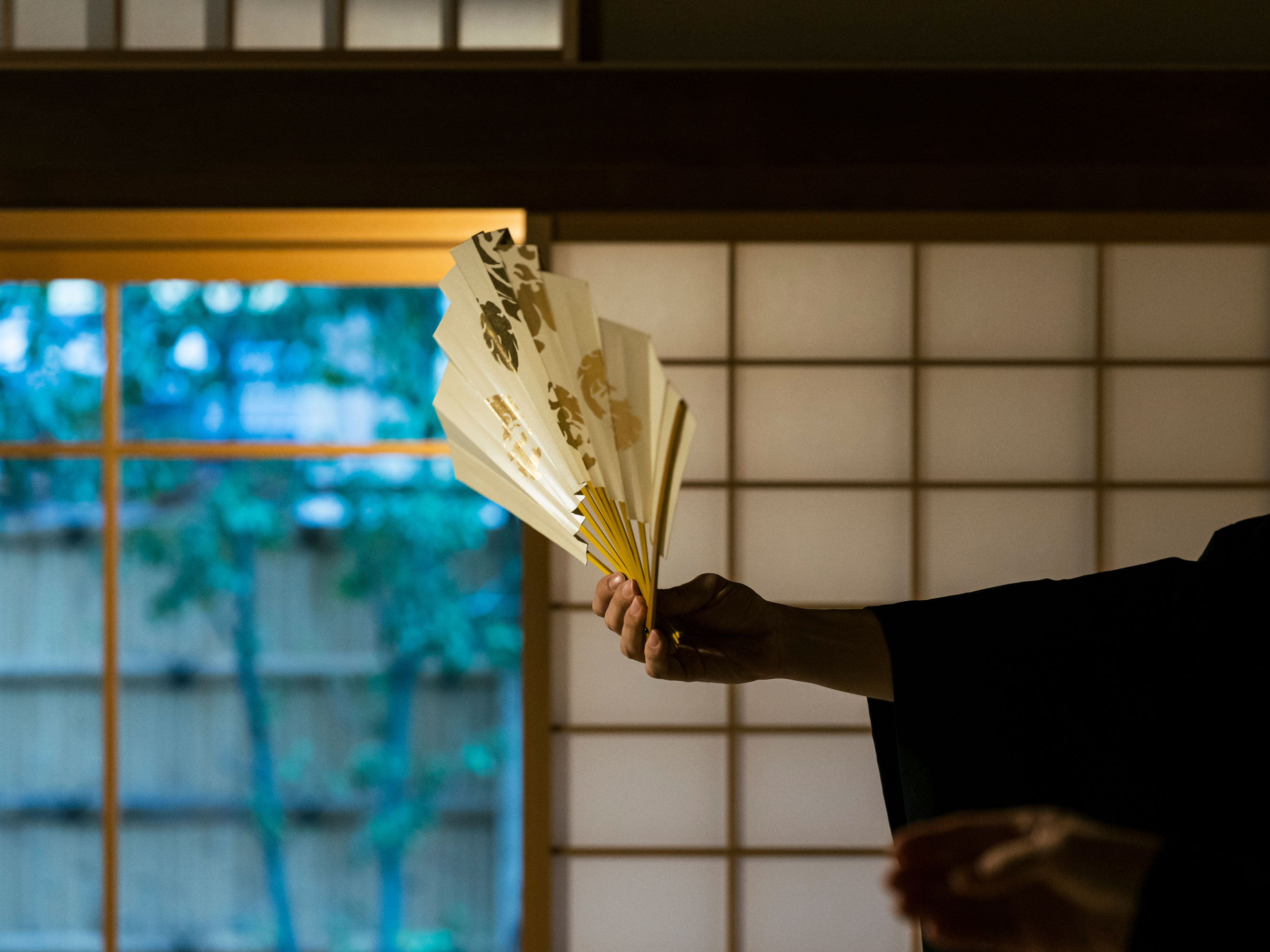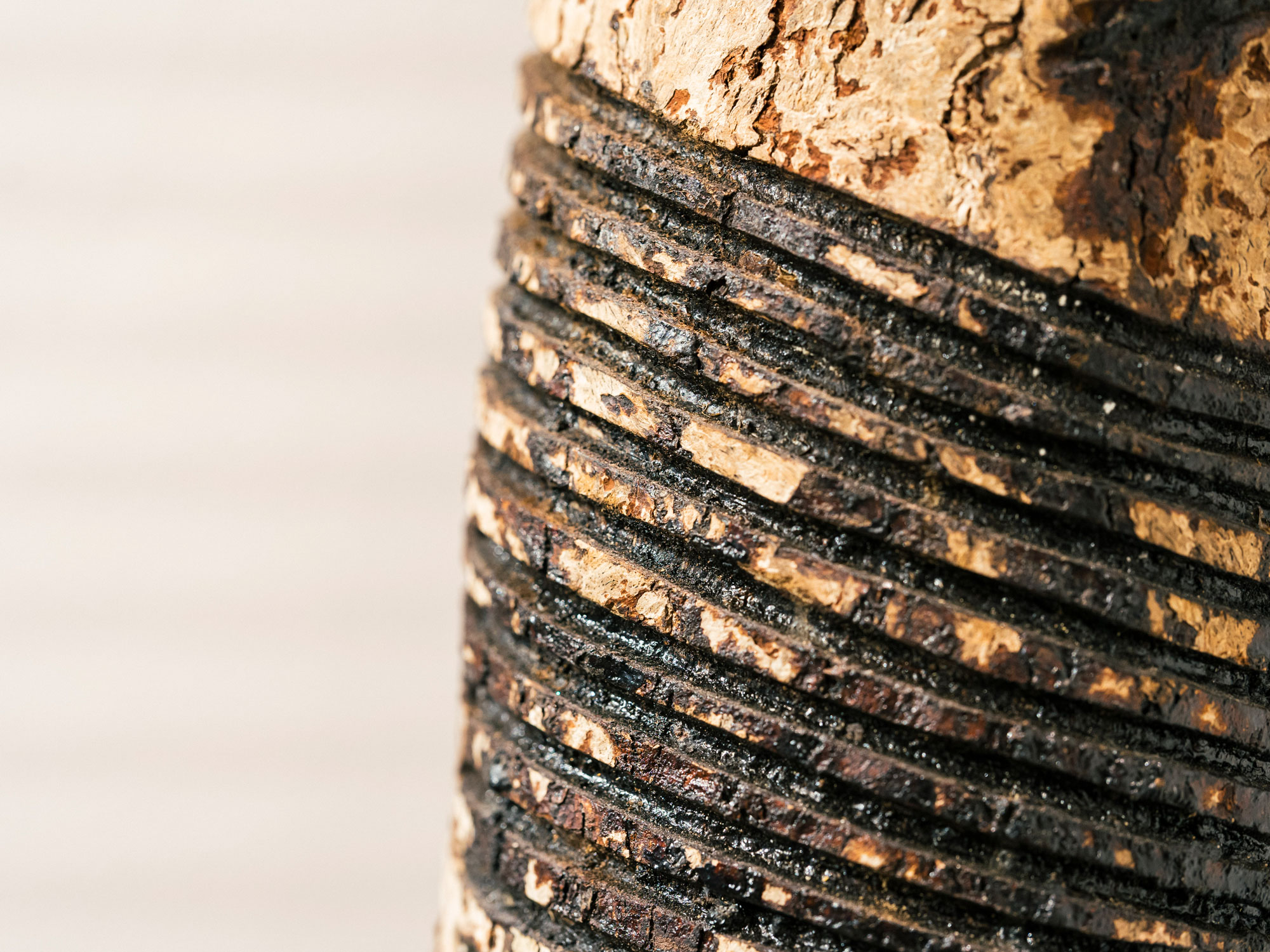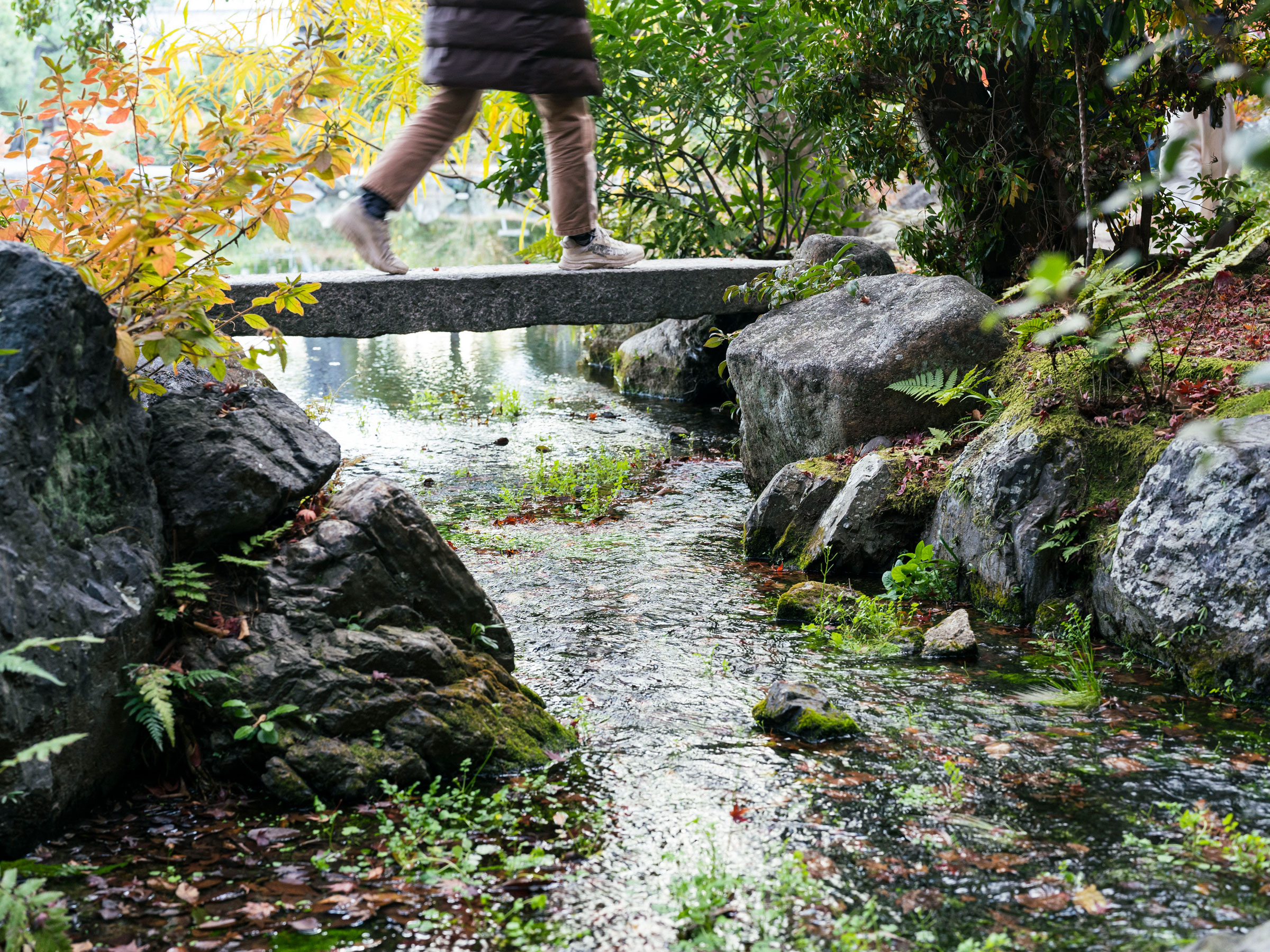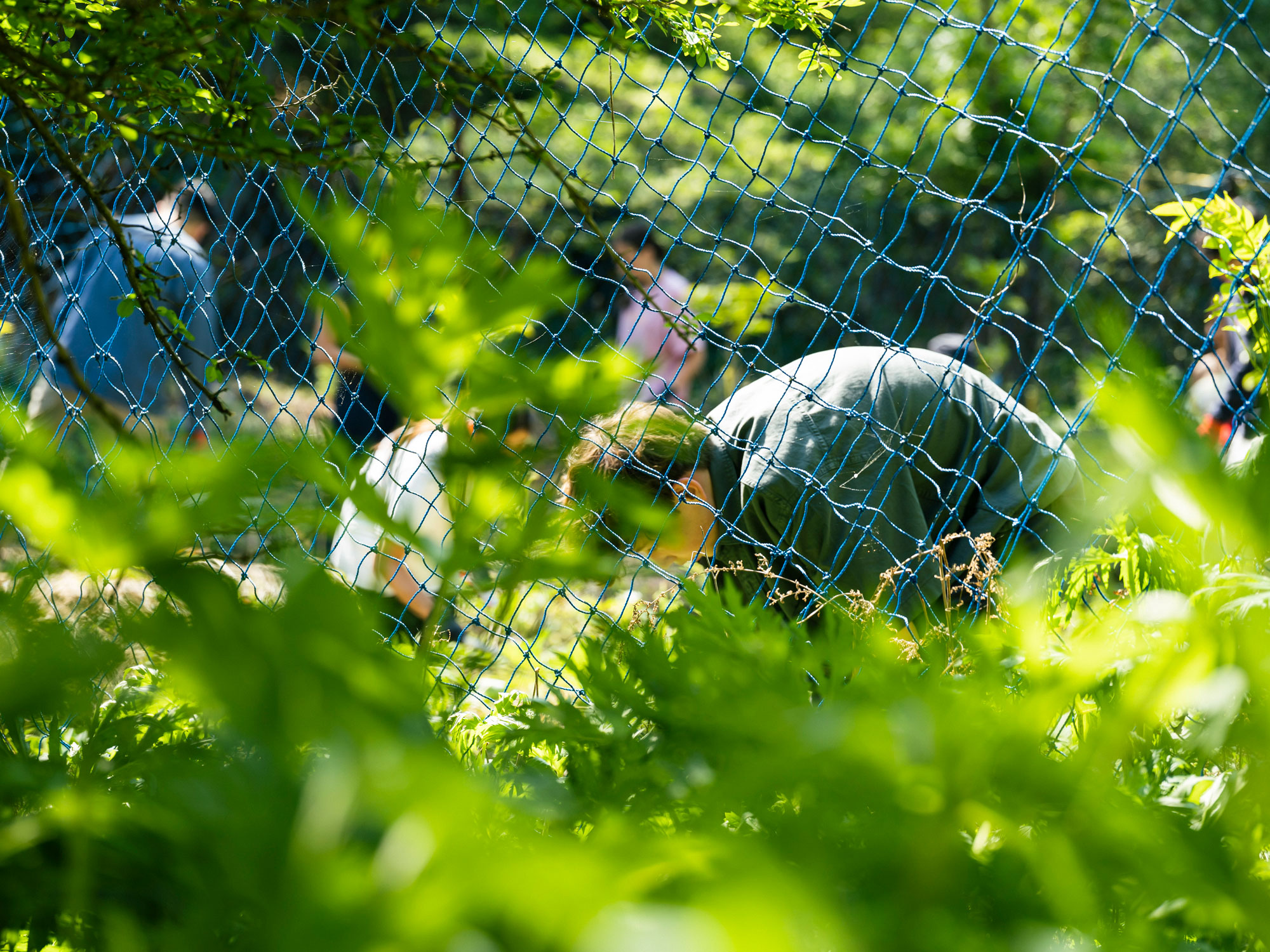
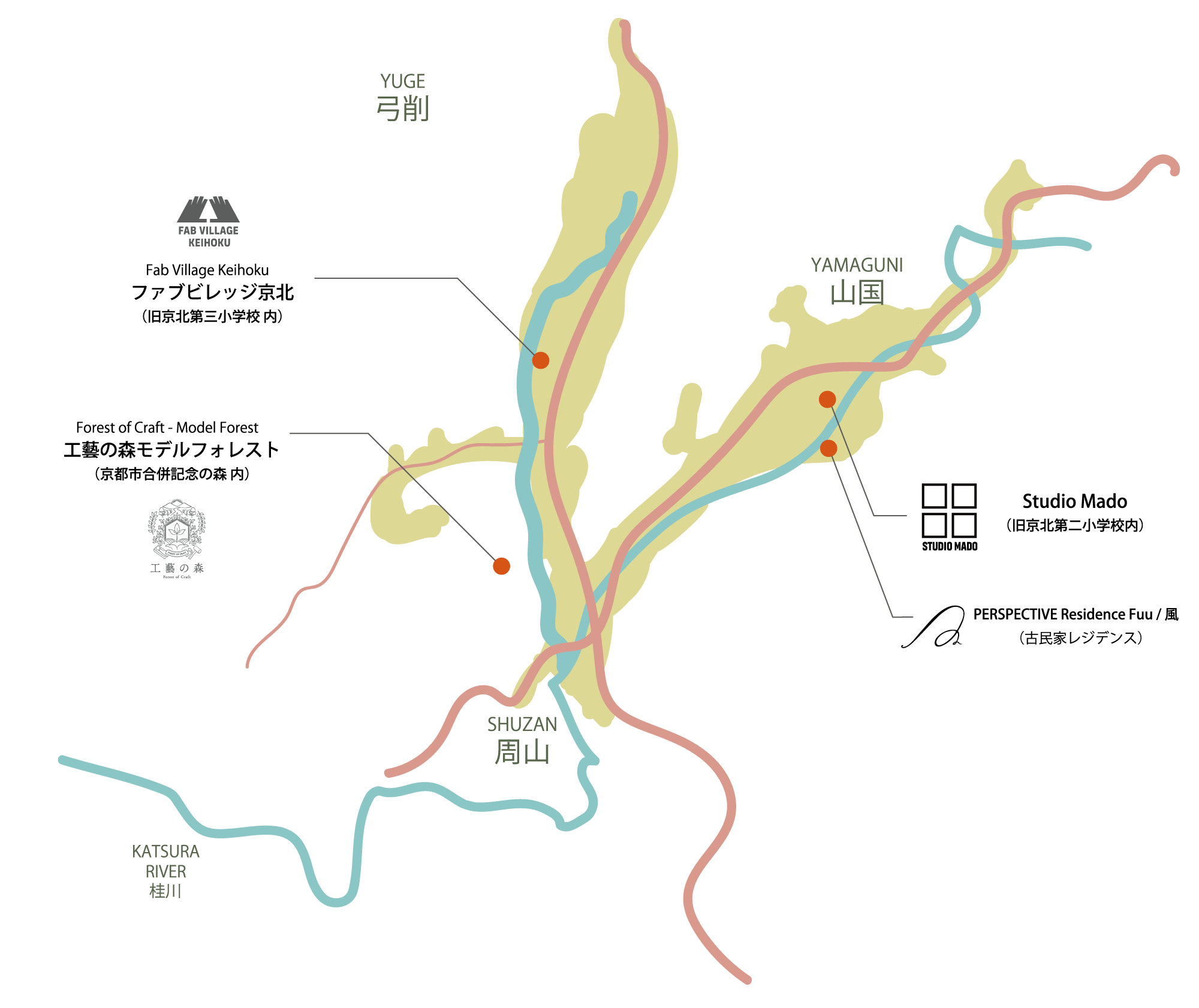
We work across the city of Kyoto and its adjacent region of Keihoku, approaching the entire watershed as a single interconnected field.
Our bases of activity (Our Spaces), local practitioners who embody regional wisdom (Local Experts), and our own initiatives—educational programs, artist residencies, and forest stewardship (The Forest of Craft)—are all interwoven into an ecosystem. Together, they form the living foundation for the learning experiences we offer.
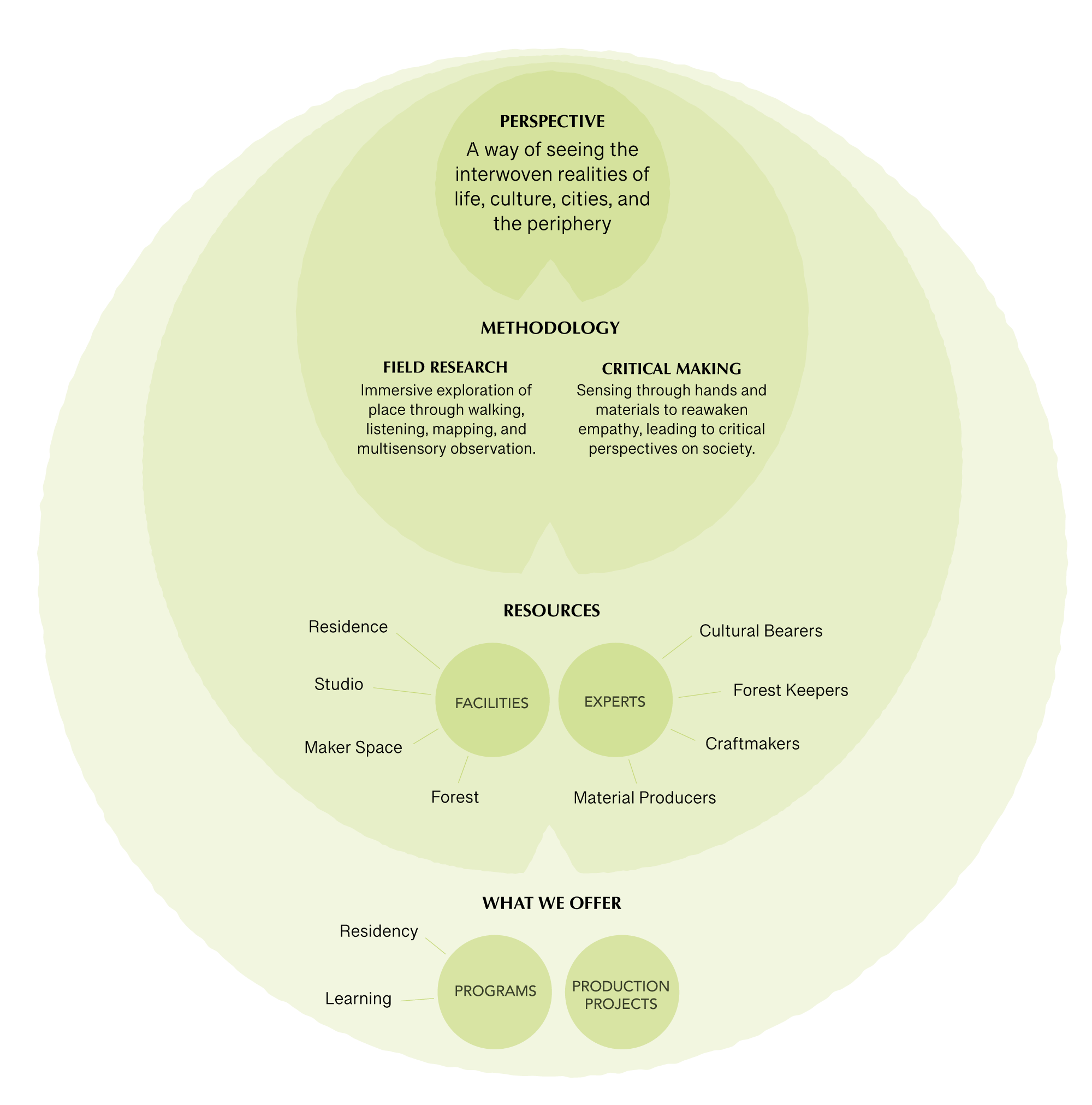
By touching materials, placing ourselves within the landscape, and engaging the body in the act of making,we begin to awaken empathy—toward others, and toward other forms of life. From this openness, questions start to emerge: questions about the systems, values, and structures that shape how we live.We value this process of thinking through the hands and the senses—a practice of making that gradually unfolds into inquiry.
Entering forests, visiting workshops, walking along rivers, and sensing the atmosphere of the city, we listen closely to the voices of landscapes, materials, and people. Through the body, we trace the relationships that sustain life in each place.Learning from ethnography as a methodology, we seek to depict the flows of culture, ecology, and economy—cultivating questions that emerge from within the field itself.This way of inquiry forms the foundation of our practice.

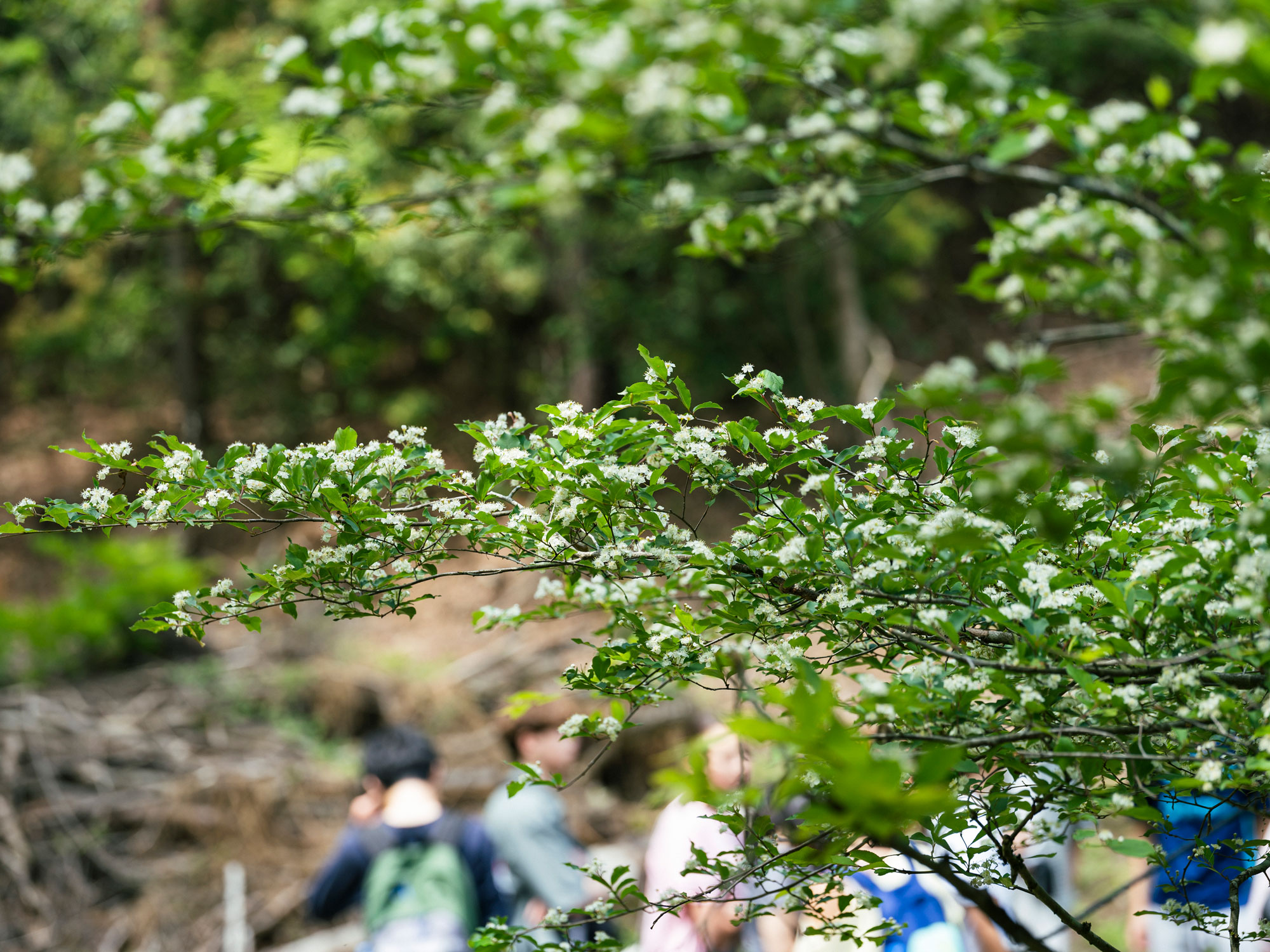
Craft begins with planting, and ultimately returns to the act of planting.In the mountains of Keihoku, we maintain an experimental forest that puts this philosophy into practice.
By planting urushi and other materials for craft with our own hands, we observe how the forest responds—its growth, its changes, and the interdependence between materials and the environment.
The forest we see today is only a brief moment in a much longer cycle of transformation, shaped by flowing water, shifting soil, and countless living beings influencing one another.
Through this living field, we continue to learn from the forest’s delicate balance and quiet strength.


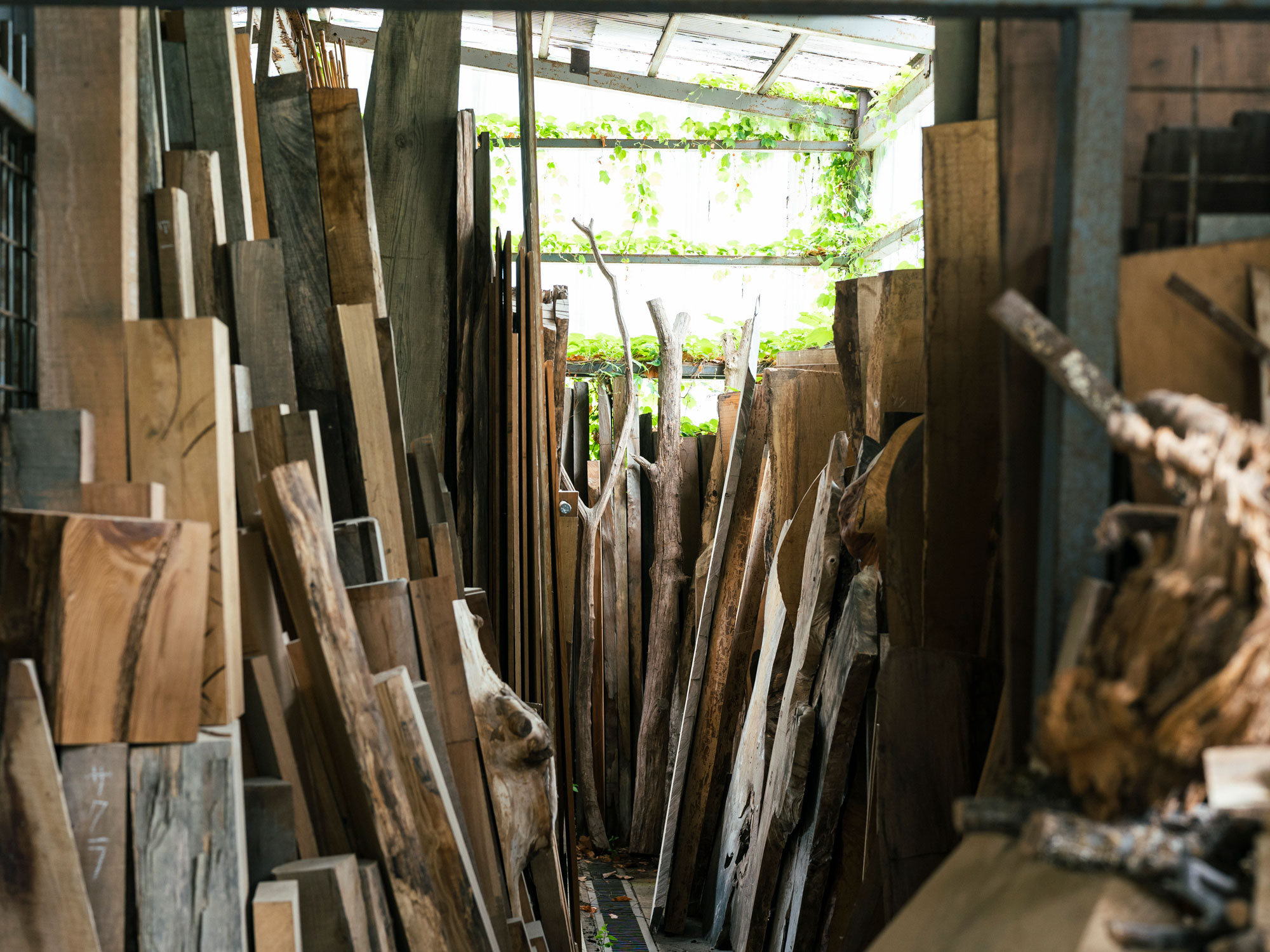
Located in Keihoku, the mountain region that once supplied Kyoto’s forests, Fab Village Keihoku (FVK) is a shared woodworking space where we reflect on the link between making and the environment.
While inspired by the global Fab Lab movement, FVK is not merely a space for digital fabrication.
It values the material wisdom and energy-conscious practices of traditional craft, grounded in the local context.
Visitors can receive guidance from experienced woodworkers and gain hands-on skills, making the space open to both seasoned makers and newcomers.
A second workshop, located nearby, offers a looser, more vernacular environment—rich with wild materials and possibilities for experimentation.
.png)
Studio Mado is a multi-purpose studio located in a former elementary school, repurposed as a base for field research and creative projects.
It is within walking distance from the Residence.
The name Mado means “window” in Japanese—reflecting our aim to create a space where landscape and memory, sensation and narrative, can meet and open new perspectives.
The space hosts exhibitions, events with local residents, and serves as a site for thinking, making, and sharing ideas rooted in place.


Residence Fuu is a 110-year-old traditional Japanese house nestled in the Yamaguni area of Keihoku, looking out toward Mount Tendo.
Just a few minutes’ walk away, the Oi River flows gently past—a place where fireflies dance in early summer, and people come from afar in search of sweetfish in midsummer.
The house has two spacious tatami rooms, one carpeted bedroom, and a fully equipped kitchen with a gas stove, rice cooker, family-sized fridge, cookware, and tableware. The bathroom and toilet are located in a detached space off the entrance. A recently renovated workspace with a desk offers ample room for both creative work and rest.
A workshop for handcrafted wooden urushi surfboards is located on-site, along with a two-story earthen storehouse and a spacious garden—providing an open environment for living, making, and thinking.


Through long-term collaboration with craftspeople and experts who carry on place-based traditions, we have built a unique, cross-disciplinary network. What we do is simply to help edit and share the thousand-year wisdom they embody, bringing it into dialogue with the wider world. At the heart of our work lies a foundation of trust—this is our greatest asset.We share this trust only with those we consider true companions, with care and intention.